Federal Reserve: Mid-2026 Interest Rate Projections at 4.5%
Anúncios
The Federal Reserve’s latest statement indicates that interest rate projections for mid-2026 are expected to remain at 4.5%, reflecting a calculated approach to economic stability and inflation management.
Anúncios
The recent announcement from the Federal Reserve has captured significant attention across financial markets and households alike. The central bank’s updated guidance reaffirms that the Federal Reserve’s latest statement: interest rate projections for mid-2026 remain at 4.5% (recent updates), providing a crucial benchmark for economic planning and investment strategies. This projection reflects a nuanced understanding of current economic realities and the path forward.
Understanding the Federal Reserve’s Mandate and Tools
The Federal Reserve, often referred to as the Fed, serves as the central bank of the United States. Its primary goals, as mandated by Congress, are to maximize employment, stabilize prices, and moderate long-term interest rates. These objectives are critical for fostering a healthy and stable economy. To achieve these goals, the Fed employs various monetary policy tools, with the federal funds rate being one of the most influential.
The federal funds rate is the target interest rate set by the Federal Open Market Committee (FOMC) at which commercial banks borrow and lend their excess reserves to each other overnight. While the Fed does not directly control this rate, it influences it through open market operations, adjusting the supply of reserves in the banking system. Changes in the federal funds rate ripple through the entire economy, affecting everything from mortgage rates and car loans to business investment and consumer spending.
The Dual Mandate: Employment and Price Stability
Balancing maximum employment and price stability is a delicate act. When the economy is overheating, with low unemployment and rising inflation, the Fed typically raises interest rates to cool down demand. Conversely, during economic downturns, it lowers rates to stimulate borrowing and spending. The current projection of 4.5% for mid-2026 suggests the Fed is navigating a complex economic landscape where inflation remains a concern, but the labor market shows resilience.
Anúncios
- Maximum Employment: Aiming for the lowest unemployment rate consistent with stable prices.
- Price Stability: Keeping inflation at a low, stable, and predictable level, typically around 2%.
- Moderate Long-Term Interest Rates: Ensuring that borrowing costs are conducive to sustainable economic growth.
The Fed’s communication is a powerful tool in itself. By providing forward guidance on interest rate projections, it aims to manage market expectations and reduce uncertainty, allowing businesses and individuals to plan more effectively. This transparency is crucial for the effective implementation of monetary policy.
Factors Influencing the 4.5% Projection for Mid-2026
The Federal Reserve’s decision to project interest rates at 4.5% by mid-2026 is not arbitrary; it’s a result of careful analysis of numerous economic indicators and a forward-looking assessment of potential challenges and opportunities. Several key factors are at play, shaping this cautious outlook.
One primary concern continues to be inflation. While there have been signs of moderation, inflation has remained stubbornly above the Fed’s target of 2%. Supply chain disruptions, geopolitical events, and robust consumer demand have all contributed to price pressures. The 4.5% projection suggests the Fed believes that current monetary policy, potentially with further adjustments, will be sufficient to bring inflation back to target within the projected timeframe, without causing an undue economic contraction.
Economic Growth and Labor Market Dynamics
Another critical factor is the state of the U.S. economy and its labor market. Despite higher interest rates, the economy has demonstrated surprising resilience. Unemployment rates have remained low, and job growth, while moderating, has continued. This strong labor market provides the Fed with some flexibility to maintain a restrictive stance on monetary policy without immediately triggering a recession.
- Persistent Inflation: Elevated price levels necessitate continued vigilance.
- Robust Labor Market: Low unemployment provides a buffer against aggressive rate hikes.
- Global Economic Conditions: International factors, including commodity prices and geopolitical stability, impact domestic inflation and growth.
The Fed also considers broader financial stability and the potential impact of its policies on different sectors of the economy. A 4.5% rate suggests a balance between curbing inflation and avoiding excessive tightening that could destabilize financial markets or significantly slow economic activity. This delicate equilibrium is at the heart of the central bank’s policymaking process.
Implications for Businesses and Consumers
The Federal Reserve’s projection of interest rates at 4.5% by mid-2026 carries significant implications for both businesses and consumers across the United States. Understanding these potential impacts is crucial for strategic planning and personal financial decisions.
For businesses, higher interest rates generally translate to increased borrowing costs. This can affect investment decisions, making it more expensive for companies to expand, purchase new equipment, or fund operations through loans. Small businesses, in particular, might feel the pinch more acutely, as they often rely on variable-rate loans. This could lead to a slowdown in hiring or even a reduction in workforce, depending on the sector and overall economic health. However, it also signifies a more stable economic environment if inflation is brought under control, which can foster long-term confidence.
Impact on Consumer Spending and Debt
Consumers will also experience direct effects. Mortgage rates, credit card interest rates, and auto loan rates are all influenced by the federal funds rate. A 4.5% projection suggests that borrowing money for major purchases will likely remain more expensive than during periods of historically low rates. This can cool consumer demand, especially for big-ticket items, which is precisely what the Fed aims for when combating inflation.
- Higher Borrowing Costs: Loans for homes, cars, and businesses become more expensive.
- Reduced Disposable Income: Increased debt service payments can squeeze household budgets.
- Savings Account Returns: Potentially higher returns on savings, though often lagging inflation.
On the flip side, higher interest rates can be beneficial for savers, as deposit rates tend to increase, offering better returns on savings accounts, certificates of deposit (CDs), and money market accounts. However, these gains often do not fully offset the impact of inflation. Overall, the 4.5% projection signals a period where financial discipline and careful budgeting will remain paramount for both individuals and corporations.
Comparing Current Projections with Historical Trends
To fully appreciate the significance of the Federal Reserve’s 4.5% interest rate projection for mid-2026, it’s helpful to place it within the context of historical trends. The Fed’s policy stance has evolved considerably over decades, reacting to various economic challenges and shifting paradigms.
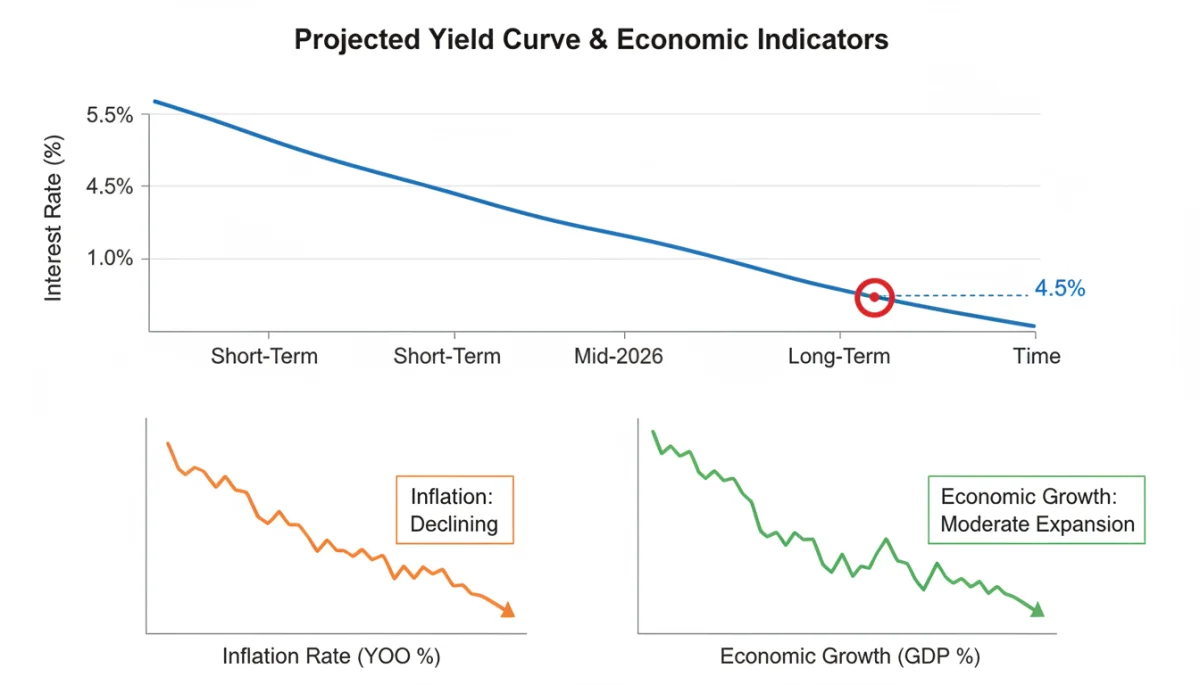
Looking back, the U.S. has experienced periods of both extremely high and remarkably low interest rates. For instance, in the late 1970s and early 1980s, the federal funds rate soared into double digits to combat rampant inflation. More recently, following the 2008 financial crisis and during the COVID-19 pandemic, rates were slashed to near zero to stimulate a struggling economy. The current projection of 4.5% represents a moderate level when compared to these extremes, indicating a return to a more normalized monetary policy environment after an extended period of exceptionally low rates.
Shifts in Monetary Policy Strategy
The Fed’s approach to monetary policy has also undergone significant shifts. Historically, the central bank might have reacted more aggressively to inflation or unemployment. However, in recent years, there’s been a greater emphasis on forward guidance and data-dependent decision-making, aiming for a more predictable and less volatile policy path. The 4.5% projection for mid-2026 reflects this nuanced, data-driven strategy.
- Post-WWII Era: Generally lower rates to support economic expansion.
- 1970s-1980s: High rates to combat stagflation.
- Post-2008 & COVID-19: Near-zero rates for economic stimulus.
- Current Era: Data-dependent approach, aiming for a ‘soft landing’.
This historical perspective reveals that the 4.5% target for mid-2026 is neither exceptionally high nor historically low. Instead, it positions the U.S. economy in a phase where the cost of money is intended to be restrictive enough to manage inflation but not so high as to stifle growth entirely. It represents a careful calibration based on current economic conditions and the lessons learned from past cycles.
Potential Economic Scenarios and Risks
While the Federal Reserve has provided a clear projection of interest rates at 4.5% by mid-2026, it’s crucial to acknowledge that economic forecasts are inherently uncertain. Several potential scenarios and risks could either affirm or alter this outlook. The Fed’s projections are always contingent on incoming data and evolving global conditions.
One significant risk is the persistence of inflation. If inflationary pressures prove to be more entrenched than anticipated, driven by factors like geopolitical instability, energy price shocks, or stronger-than-expected wage growth, the Fed might be compelled to maintain higher rates for longer or even raise them further. This could lead to a more significant economic slowdown or even a recession, often referred to as a ‘hard landing’.
Geopolitical Events and Supply Chain Disruptions
Conversely, an unexpected rapid deceleration in inflation, perhaps due to a significant easing of supply chain issues or a sharp drop in commodity prices, could allow the Fed to consider earlier rate cuts. This ‘soft landing’ scenario, where inflation returns to target without a severe economic contraction, is the Fed’s ideal outcome but remains challenging to achieve.
- Sticky Inflation: Requires sustained restrictive monetary policy.
- Economic Downturn: Could force the Fed to lower rates sooner than projected.
- Geopolitical Shocks: Can disrupt markets and supply, impacting inflation and growth.
Furthermore, unforeseen geopolitical events, such as new conflicts or trade wars, could introduce significant volatility. These events can impact global supply chains, energy prices, and investor confidence, all of which would influence the Fed’s decision-making process. The 4.5% projection for mid-2026, therefore, should be viewed as a baseline, subject to adjustments based on the dynamic interplay of these economic forces and risks.
The Role of Data in Federal Reserve Decisions
The Federal Reserve’s monetary policy decisions, including its interest rate projections, are fundamentally data-driven. The FOMC, the Fed’s primary policymaking body, meticulously analyzes a vast array of economic data points before making any adjustments to the federal funds rate or issuing forward guidance. This reliance on data ensures that policy decisions are informed by the most current and comprehensive understanding of the economy.
Key economic indicators that the Fed closely monitors include inflation reports, such as the Consumer Price Index (CPI) and the Personal Consumption Expenditures (PCE) price index, which is its preferred measure. Labor market data, including unemployment rates, job growth figures, and wage growth, also play a crucial role in assessing the health of the economy and the potential for inflationary pressures. Furthermore, data on consumer spending, business investment, manufacturing output, and housing market activity provide a holistic view.
Forward Guidance and Economic Projections
Beyond historical data, the Fed also relies on economic projections from its staff and the individual members of the FOMC. These projections, often summarized in the ‘Summary of Economic Projections’ (SEP) and visualized in the ‘dot plot’, provide insights into where policymakers expect key economic variables, including interest rates, to be in the future. The 4.5% projection for mid-2026 is a direct outcome of this rigorous forecasting process.
- Inflation Measures: CPI and PCE are closely watched for price stability.
- Labor Market Indicators: Unemployment, job growth, and wage trends inform employment goals.
- Growth Data: GDP, retail sales, and industrial production reflect economic activity.
This data-centric approach allows the Fed to be flexible and responsive to changing economic conditions. While the 4.5% projection provides a roadmap, the Fed has repeatedly emphasized that its policy will remain agile, adjusting as new information becomes available. This commitment to data-driven decision-making is essential for maintaining credibility and effectively guiding the economy towards its dual mandate objectives.
| Key Aspect | Brief Description |
|---|---|
| Interest Rate Projection | Federal Reserve projects 4.5% federal funds rate by mid-2026. |
| Inflationary Concerns | Policy aims to combat persistent inflation towards 2% target. |
| Economic Impact | Affects borrowing costs for businesses and consumers. |
| Data-Driven Policy | Decisions are based on comprehensive economic data and forecasts. |
Frequently Asked Questions About Federal Reserve Projections
For the average consumer, a 4.5% interest rate projection for mid-2026 implies that borrowing costs for mortgages, car loans, and credit cards will likely remain elevated. While savings accounts might offer slightly better returns, the overall cost of debt will be higher than in recent years, requiring careful financial planning.
The Federal Reserve aims for a 2% inflation target because it believes this level fosters price stability while allowing for healthy economic growth. Too low inflation can lead to deflationary spirals, while too high inflation erodes purchasing power and creates economic uncertainty, hindering long-term planning.
The Federal Reserve’s Federal Open Market Committee (FOMC) typically updates its economic projections, including interest rate forecasts, four times a year. These updates are released in conjunction with their March, June, September, and December meetings, providing regular insights into their evolving outlook.
Yes, the Federal Reserve’s projections are not set in stone and can certainly change. These forecasts are based on current economic data and assumptions. Significant shifts in inflation, employment, or global economic conditions could prompt the Fed to revise its outlook and adjust its monetary policy stance accordingly.
The ‘dot plot’ is a graphical representation within the Summary of Economic Projections (SEP) that shows each FOMC member’s projection for the federal funds rate at various points in the future. It offers a visual snapshot of the committee’s collective expectations and the dispersion of individual forecasts, providing transparency into the 4.5% mid-2026 projection.
Conclusion
The Federal Reserve’s reaffirmation of a 4.5% interest rate projection for mid-2026 underscores a strategic and data-driven approach to managing the U.S. economy. This outlook reflects the central bank’s ongoing commitment to balancing inflation control with sustained employment, navigating a complex economic landscape marked by persistent price pressures and resilient growth. While this projection offers a critical benchmark for financial planning, its ultimate realization remains contingent on a dynamic interplay of economic data, geopolitical developments, and the Fed’s flexible response to evolving conditions. For businesses and consumers alike, understanding this guidance is essential for making informed decisions in an ever-changing financial environment, emphasizing the need for continued vigilance and adaptability.