Unemployment Rate Projections for 2026: Steady at 3.8% Amidst Economic Shifts
Anúncios
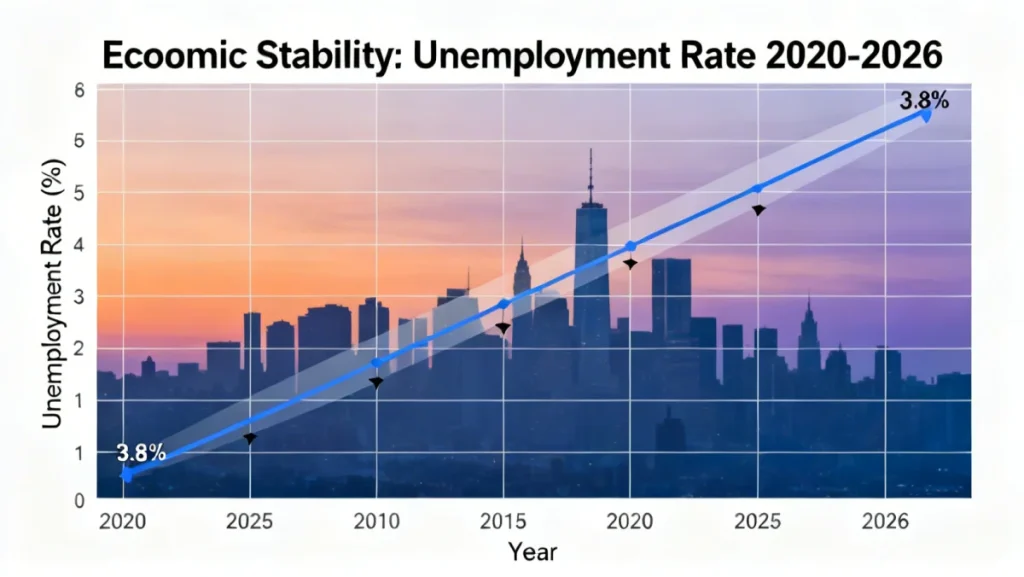
The United States is projected to maintain a steady 3.8% unemployment rate in 2026, reflecting a resilient labor market amidst ongoing economic adjustments and strategic policy responses.
Anúncios
The latest outlook suggests that the unemployment rate projections for 2026 remain steady at 3.8% amidst economic adjustments, offering a stable picture for the American labor market. This consistency in forecasts provides a crucial insight into the anticipated economic landscape, prompting a deeper exploration into the factors at play.
Understanding the Current Economic Climate and Its Influence
The current economic climate is a complex interplay of various forces, from global supply chain dynamics to domestic consumer behavior. These elements collectively shape the demand for labor and, consequently, the unemployment rate. A stable projection for 2026 suggests that economists anticipate a continued balancing act between growth and inflation.
Recent data indicates a resilient economy, even in the face of persistent inflationary pressures and interest rate hikes. This resilience is largely attributed to robust consumer spending and a surprisingly adaptable business sector. Understanding these foundational elements is key to appreciating why the unemployment forecast remains unchanged.
Key Economic Indicators Shaping the Outlook
Several key economic indicators are closely monitored to form these projections. Gross Domestic Product (GDP) growth, inflation rates, and consumer confidence indices all play significant roles. When these indicators show a balanced trajectory, it often translates into stable labor market forecasts.
Anúncios
- GDP Growth: Moderate and consistent GDP growth supports job creation without overheating the economy.
- Inflation Trends: Controlled inflation allows for steady wage growth and stable purchasing power, benefiting both employees and employers.
- Consumer Confidence: High consumer confidence typically leads to increased spending, which in turn stimulates business activity and hiring.
- Interest Rates: Stable interest rates provide predictability for businesses seeking to invest and expand, fostering employment opportunities.
The convergence of these indicators paints a picture of an economy that, while not without its challenges, is expected to navigate the coming years with a degree of stability. This foundational understanding is crucial for interpreting the steady unemployment rate projections.
In essence, the current economic climate is characterized by a cautious optimism. Businesses are adapting to new market realities, and consumers continue to drive demand. This adaptability is a significant factor in the sustained stability of employment forecasts.
Labor Market Dynamics: Supply, Demand, and Skill Gaps
The labor market is a dynamic ecosystem where the supply of available workers meets the demand from employers. Analyzing these dynamics is essential for understanding unemployment projections. Even with a steady overall rate, underlying shifts in specific sectors and skill requirements are continuously occurring.
The past few years have highlighted significant transformations in how and where people work, as well as the skills most valued by employers. This evolution continues to influence the balance between job seekers and available positions, impacting the overall unemployment landscape.
Evolving Workforce Needs and Automation
Automation and technological advancements are consistently reshaping the types of jobs available and the skills required. While some fear job displacement, many economists see this as a shift towards higher-skilled, more specialized roles. This requires ongoing education and reskilling initiatives to ensure the workforce remains competitive.
- Technological Upskilling: Demand for digital literacy and specialized tech skills continues to rise across all industries.
- Soft Skills Importance: Critical thinking, problem-solving, and adaptability are becoming increasingly vital for navigating complex work environments.
- Green Economy Jobs: Growth in renewable energy and sustainability sectors is creating new job categories.
These shifts mean that even with a stable unemployment rate, there might be localized or sectoral imbalances. Addressing these skill gaps through targeted training programs and educational reforms is paramount for maintaining long-term labor market health.
The interplay of supply and demand for specific skills will be a defining characteristic of the 2026 labor market. Policies that encourage workforce development and flexibility will be crucial in ensuring that the steady unemployment rate reflects a healthy and inclusive job market for all.
Policy Interventions and Their Impact on Employment
Government policies play a pivotal role in shaping economic outcomes, including employment rates. Fiscal and monetary policies are continuously adjusted to respond to economic shifts, aiming to foster growth, control inflation, and maintain a stable labor market. The 3.8% unemployment projection for 2026 suggests that current and anticipated policy interventions are expected to be largely effective.
Understanding the nature of these interventions—and their intended and unintended consequences—is crucial for comprehending the stability of the employment outlook. Central banks and legislative bodies work in tandem to create an environment conducive to job creation and economic security.
Monetary Policy Strategies
The Federal Reserve’s monetary policy, primarily through interest rate adjustments and quantitative easing or tightening, significantly influences business investment and consumer spending. Stable interest rates can encourage businesses to expand and hire, while unpredictable changes can create uncertainty.
- Interest Rate Management: The Fed’s careful calibration of interest rates aims to cool inflation without stifling economic growth or job creation.
- Inflation Targeting: Maintaining price stability is a core objective, as high inflation erodes purchasing power and can destabilize the labor market.
- Forward Guidance: Clear communication from the Fed regarding future policy intentions helps businesses and consumers plan, reducing market volatility.
These monetary strategies are designed to provide a stable economic foundation, indirectly supporting a consistent demand for labor. The anticipation of continued measured approaches by the Fed contributes to the steady unemployment forecast.
Sector-Specific Employment Trends and Growth Areas
While the overall unemployment rate provides a broad picture, a deeper dive into sector-specific employment trends reveals a more nuanced reality. Different industries experience varying levels of growth, contraction, and transformation, which collectively contribute to the aggregate employment figures. The 3.8% projection implies a balance across these diverse sectors.
Understanding which sectors are growing and which are facing challenges is vital for both job seekers and policymakers. This granular view helps in identifying opportunities and addressing potential vulnerabilities within the labor market.

Emerging Industries and Resilient Sectors
Several industries are projected to be significant drivers of job growth leading up to and into 2026. These often include sectors undergoing rapid technological advancement or those addressing evolving societal needs. Conversely, some traditional industries may continue to face automation pressures or shifting consumer preferences.
- Technology Sector: Continued expansion in software development, AI, data science, and cybersecurity roles.
- Healthcare and Social Assistance: Driven by an aging population and advancements in medical technology, demand for healthcare professionals remains robust.
- Renewable Energy: Significant investment in green technologies is creating new jobs in manufacturing, installation, and research.
- Logistics and E-commerce: The continued growth of online retail fuels demand for workers in warehousing, delivery, and supply chain management.
Even traditional sectors like manufacturing are seeing a resurgence, albeit with a greater emphasis on advanced manufacturing techniques and skilled labor. The resilience of these sectors, coupled with growth in emerging fields, underpins the stability of the overall unemployment rate.
The diverse performance of these sectors highlights the adaptability of the U.S. economy. This adaptability is a key factor in absorbing economic shocks and maintaining a relatively stable labor market, reinforcing the 2026 unemployment projections.
Global Economic Influences and Trade Relations
The United States economy does not operate in isolation; it is deeply intertwined with global economic trends and international trade relations. Fluctuations in global demand, geopolitical events, and trade policies can all exert significant influence on domestic employment figures. The steady 3.8% unemployment rate projection for 2026 implicitly accounts for these external factors.
Understanding the global context is crucial for a comprehensive view of the domestic labor market. International trade, foreign investment, and global supply chains directly impact various U.S. industries and, consequently, job availability.
Impact of Geopolitical Stability and Trade Agreements
Geopolitical stability is a cornerstone for predictable international trade and investment. Conflicts or significant political instability in other regions can disrupt supply chains, increase commodity prices, and dampen global demand, all of which can ripple through to the U.S. labor market.
- Supply Chain Resilience: Efforts to diversify and strengthen supply chains reduce vulnerability to international disruptions.
- Trade Agreements: Favorable trade agreements can open new markets for U.S. goods and services, supporting export-oriented jobs.
- Global Demand: A healthy global economy boosts demand for American products, benefiting manufacturing and service sectors.
The U.S. government’s approach to trade relations and its efforts to foster international cooperation play a significant role in mitigating external risks. The anticipation of continued stability in these areas contributes to the consistent unemployment forecast.
In conclusion, the global economic landscape, while inherently unpredictable, is currently viewed as stable enough not to significantly derail domestic employment trends. This international perspective is an indispensable part of forecasting the future of the U.S. labor market.
Forecasting Methodologies and Data Reliability
The reliability of unemployment rate projections hinges significantly on the sophistication of forecasting methodologies and the accuracy of underlying data. Economists and government agencies employ a variety of models and data sources to arrive at these crucial figures. The consistent 3.8% projection for 2026 reflects confidence in these analytical tools and the quality of information available.
Understanding how these forecasts are made provides valuable insight into their credibility. It involves rigorous statistical analysis, economic modeling, and continuous data collection and refinement.
Advanced Models and Data Sources
Economic forecasting is far from a simple estimation; it involves complex econometric models that integrate numerous variables. These models are constantly updated with new data and refined based on past performance, enhancing their predictive power.
- Time Series Analysis: Examining historical unemployment data to identify patterns and trends.
- Econometric Models: Using statistical relationships between economic variables (like GDP, inflation, interest rates) to predict future outcomes.
- Labor Force Surveys: Regular surveys of households and businesses provide real-time data on employment, unemployment, and wages.
- Leading Indicators: Analyzing indicators that tend to change before the economy as a whole, such as new unemployment claims or manufacturing orders.
The combination of these methods allows forecasters to build a comprehensive picture of the labor market’s future trajectory. The stability of the 2026 unemployment projection suggests a broad consensus among different models and data interpretations.
The robustness of these forecasting methodologies and the continuous effort to collect and analyze reliable data are fundamental to the trust placed in these economic outlooks. This analytical rigor supports the consistent 3.8% unemployment rate projection.
| Key Point | Brief Description |
|---|---|
| Steady 2026 Projection | Unemployment rate expected to hold at 3.8%, reflecting economic resilience. |
| Economic Adjustments | Ongoing shifts in inflation, interest rates, and global trade influencing the outlook. |
| Labor Market Dynamics | Skill gaps and evolving job requirements are key factors in workforce balance. |
| Policy Impact | Fiscal and monetary policies play a crucial role in maintaining employment stability. |
Frequently Asked Questions About 2026 Unemployment Projections
A 3.8% unemployment rate is generally considered near full employment, indicating a healthy and robust labor market. It suggests that most individuals who want to work can find jobs, contributing to economic stability and growth.
Projections two years out, like for 2026, are based on sophisticated models and current data, offering a reasonable outlook. While unforeseen events can alter forecasts, they provide a strong indication of expected trends, guided by expert consensus.
Significant deviations could arise from major global economic shocks, unexpected shifts in inflation or interest rates, rapid technological disruptions, or substantial changes in government policy. These events could either push the rate higher or lower.
Yes, sectors like technology, healthcare, renewable energy, and logistics are anticipated to experience robust job growth. These industries are driven by innovation, demographic shifts, and evolving consumer demands, creating numerous employment opportunities.
Government fiscal and monetary policies, including tax measures, spending programs, and interest rate adjustments, directly impact economic activity and business investment. These interventions are crucial in steering the economy towards stable employment levels and mitigating downturns.
Conclusion
The consistent projection of a 3.8% unemployment rate for 2026 reflects a cautiously optimistic outlook for the U.S. labor market. This stability is underpinned by a resilient economy, adaptable labor market dynamics, strategic policy interventions, and a robust global economic environment. While future economic conditions are always subject to change, the current consensus points towards a sustained period of relatively low unemployment. This forecast offers valuable insights for policymakers, businesses, and individuals alike, guiding decisions related to investment, workforce development, and career planning in the coming years. The ongoing monitoring of key economic indicators and an agile policy response will be vital to maintaining this stable employment trajectory.